
CFD trading lets you speculate on price movements of Forex, indices, commodities, and shares — without owning the asset. Trade rising or falling markets from one simple platform.
A CFD (Contract for Difference) allows you to trade on the price movement of an asset without buying it. You simply profit or lose based on whether the price goes up or down.
If you think the price will rise
If you think the price will fall
Trade with confidence using a regulated broker offering competitive spreads, fast execution, and zero commission. Access powerful tools and trade on MT5, one of the world’s most popular platforms — everything you need to trade smarter, all in one place.
Step into the world of trading with access to fast-moving Forex, major indices, commodities like gold and oil, and leading global shares — all from one simple platform.

Trade global currency pairs 24/5 with high liquidity and fast-moving opportunities.

Choose a market
Decide Buy or Sell
Monitor and close your trade
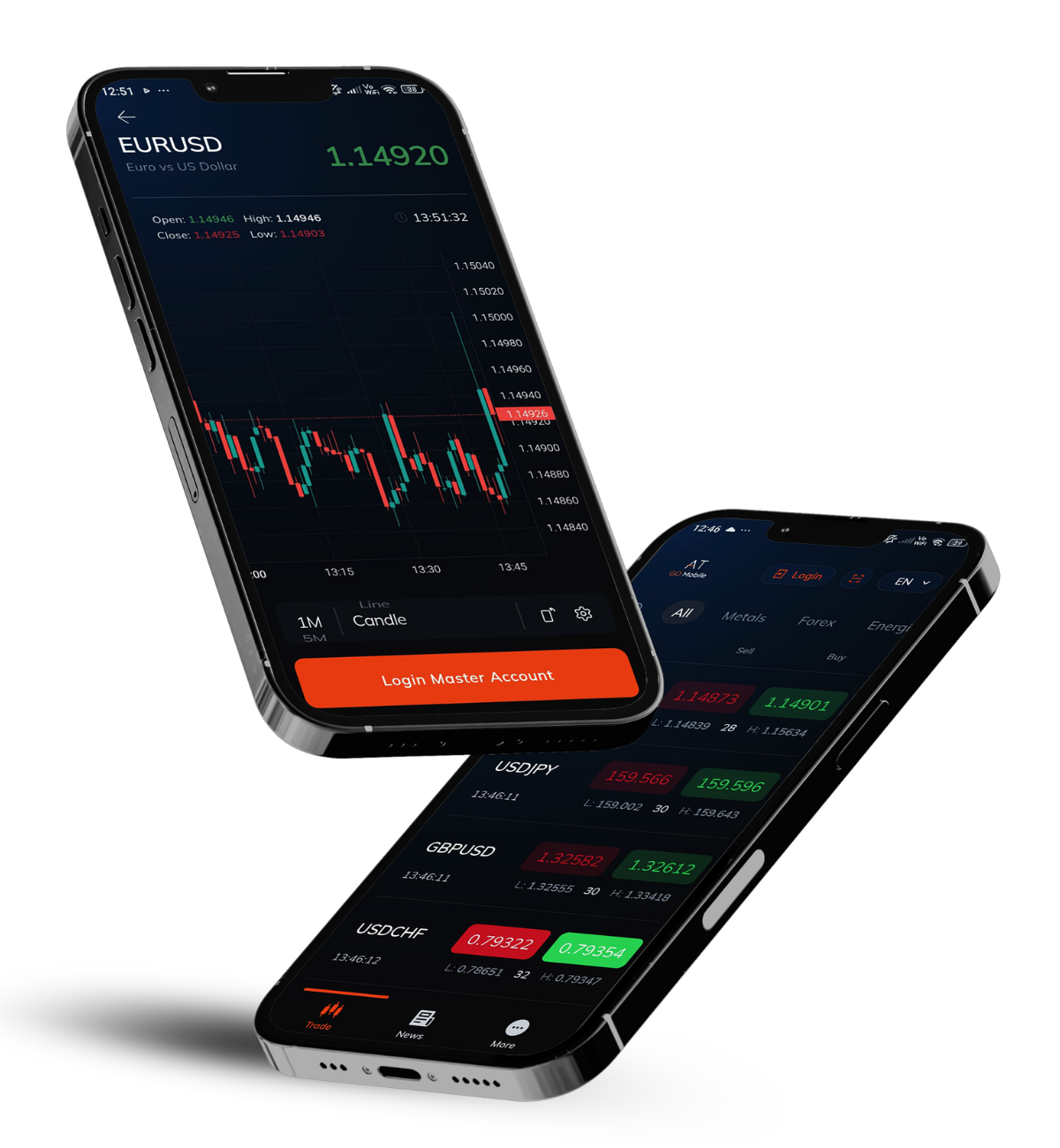
Access global markets from your desktop or mobile with fast, reliable trading platforms. Monitor prices in real time, analyse charts, and place trades instantly — all from one simple interface.
Stay updated with live prices, charts, and market insights.
Available on desktop, mobile, and tablet.
Use charts and indicators to make smarter trading decisions.
Track and trade multiple instruments from a single platform.
Practice Before You Trade
You can trade CFD in both rising markets and declining markets. Speculators will place ‘buy orders’ (long positions) when they anticipate the prices will appreciate and place ‘sell orders’ (going short) when they expect a decline. CFDs offer the opportunity to profit from rising and declining market trends.
As the standout advantage of trading CFDs, you can immediately realize profits. Investors, in turn, have lesser risks of potential loss when the markets are mostly bearish.
Like all forms of trading, always not that you are still exposed to some risks while trading CFD. Choose a trading style that you are comfortable with and one that will still keep your bankroll manageable if your price prediction does not materialize.
Here are some practical trading styles you can use to make consistent profits while having manageable risk exposure.
Day trading is a trading choice where investors only keep positions running for a maximum of a day. Most traders may also open and close positions on one instrument multiple times within one trading session. Day trading works best with more volatile price action on a liquid instrument. Because of cost implications, the best CFD broker offers low transaction charges
Short-term traders give priority to CFDs because speculative trades only need a small price movement for there to be profit opportunities. Because of the hunt for small price differences, short-term traders rely on technical analysis more than fundamental analysis. They focus more on the price trend than the company’s actual performance or currency.
A common variation of day trading is scalping. It is very short-term and can have positions that only remain open for seconds. You can trade CFD with small, consistent profits, which add up to a substantial amount if you stay focused.
The rationale behind closing the losses as soon as they occur is that, hopefully, the winning trades will cover the losses.
Day trading and scalping are high-probability trading techniques that bear minimal risk. Use them with tight stops and clear profit objectives always. Consider them as a trick to make 100 trades to get $100.
Position trading of CFDs requires a long-term approach to how the investor determines the likely price movement. Position trading, unlike scalping, gives the long-term price trend higher priority than how the market fluctuates in the short term.
For example, the bullish trader will keep a position open even if the day is closed on a bearish note. The strategy prescribes making more significant gains over a more extended period as long as a stop loss is not hit.
The fundamental analysis of picking the trades involves more profound research into the underlying companies’ financial performance and management track record. It involves more news-tracking than short-term strategies.
To get started, use the charts to find the trend direction and strength. It is more profitable to trade CFDs in the direction of the trend. Place the trade and keep monitoring open positions to guard against trend changes.
Long-term trades attract margin costs
Margin interest is the cost of borrowing money from a broker to trade, and it accrues daily based on the amount of margin used by the trader.
Trading CFDs with a long-term perspective, therefore, has some cost implications. CFDs are margined instruments that will attract interest over the duration you hold the positions. When a trader holds a long-term position, they are essentially borrowing funds from their broker to maintain the position until they decide to close it.
As long as the position remains open, the trader will be charged margin interest on the borrowed funds. The amount of margin interest charged is typically calculated based on the size of the position and the amount of time that the position is held open.
Always incorporate the margin costs into the trading strategies to judge whether some trades will be profitable.
An excellent way to compensate for the daily interest is to invest a higher ratio of your trades in CFD stocks with a strong trend. The price changes will cover the interest charges.
Qualities of a good trading system
If you still feel unsure about your trading strategy, consider using the following 4 characteristics to test if it is good.
Regardless of the system, always confirm how much you can lose with a single trade, as CFDs are leveraged products. When setting a profit target, set a reasonable stop-loss distance. Your stop-loss distance should be at least half the number of pips you set as the take profit.
Even as we know the importance of a trading platform and how to trade, it is vital to know the CFD broker meaning and their role in the equation. CFD brokers are intermediaries who play the market maker role. They will match orders from clients and take asset positions to hedge exposure. Brokers would profit from clients’ trades, even if they were not winning trades.
A financial institution will offer value-added services to give the clients the best value and set themselves apart from competitor brokers. Give priority to brokers who provide services such as free market analysis and trading signals. Due to competition, most of these services are free, but for the benefits you get in return, it is okay to pay a small fee. Most of the fees charged for those services are negligible to your trades. It is fair for brokers to request a minimum deposit if they want a CFD trading platform that offers the services.
Some value-added services that you should look out for from a broker include
These help traders monitor trends and deal directly from an HTML5 browser or MT5 platform without having to rely on a list of quotes like traditional exchanges.
Even if you cannot access your computer for long periods, trading alerts let you receive updates on economic events and critical economic indicators via phone texts.
Brokers have different performance speeds on their platforms. Good brokers ensure there is minimal slippage or lag. Withdrawals are executed quickly to get your money in your hands when needed.
Instead of just a handful of popular demands and instruments, you can access exotic markets from your CFD broker online. These still offer reliable execution time.
Select a trustworthy broker who updates the platform with the latest security standards.
In summary, most top-ranked brokers can meet the needs of short and long-term traders. Day traders prefer shorter periods to find opportunities, so they need to sign up with a broker who offers a more extensive range of instruments to trade daily. Short-term traders benefit more from the scouting tools that make it easier to find trading opportunities. Professional traders are more likely to register for a signal service and a detailed economic calendar. CFD brokers like ATFX provide formidable tools and training for professional CFD traders.
Trading CFDs needs traders to have a way to monitor opportunities and analyze opportunities in real-time, or else they will bag losses. Online CFD accounts make opening positions and managing risk parameters easy.
CFD trading accounts are portals through which traders can access the market. Your account shows your trades, cash balance, and any correspondence history between you and the broker. Thankfully, you can access your account through applications you download and install on a mobile phone or PC.
An easy-to-register platform allows you to access your trading account and participate in thousands of markets from anywhere. Expect more convenience from your trading account, with additional features like educational materials, expert coaches, and round-the-clock customer support. Traders must register an online CFD account to make their trades online.
Registering a CFD account with an online broker is no longer difficult. CFD brokers are outshining each other with new features that make it easy for traders to participate in the market profitably. ATFX has a simple and quick account creation process in place. It only takes a few minutes to create an account, register, and fund it. Now, you can have your first trades running on a top-notch CFDs trading platform.
All platforms require you to visit their sign-up pages and provide basic details about yourself. Once you are done giving your details, your trading broker will send a confirmation email to your inbox to verify that nobody else is using your email to create an account. Authenticate your account and sign in to customize your account with a few more tools and essential onboarding.
The onboarding process takes you through all the basics you need to know about accessing trading tools, contacting support teams, and depositing funds.
Follow these simple steps if you have been thinking of opening an account at ATFX.com:
The first instance involves filling out a simple form that gets unique details about your identity. Typically, it would help if you filled in your name (as they appear on your ID card) and email address. The secondary part of the registration forms needs your address, preferred password, and confirmation that you are over 18 years. Tick the checkbox that confirms that you have read and agree with the terms and conditions.
For your safety, brokers ask for your identification documents. This information reduces the loopholes that money launderers are out for. Identification prevents your account from being hijacked by intruders. It’s not that often that an online stranger in a different country will know your exact residence, birth date, and such private information.
As a precaution to ensure that you are the one opening the account, brokers will ask for a scanned copy of your ID or Driving license. A driving license or a recent bill proves that an applicant uses his actual address. The identification documents ensure that the ID matches the photos uploaded in the verification process.
Other documents that can be used as alternatives include stamped bank statements, tax PINs, or recent utility bills. These are last-resort documents if there are problems with other document submissions. To avoid any doubts, always ensure that the names used in your application are the names that appear in the supporting application documents. Conflicting documents prolong the application process.
Once you have an account under your name, the next step is selecting the software platform that you will log in to trade.
Metatrader 4 (MT4) is the go-to platform for most beginners. It has all the charting tools and trade placement buttons you need. It is arguably the best platform because most other platforms are variations of MT4. Furthermore, MT4 and MT5 are customizable to your trading styles and are good for testing how well trading strategies work.
Online CFD brokers provide a variety of trading widgets and tools to link to your MT4 or browser platforms to help you easily identify chart patterns. Some examples include ‘auto-chartist’ and links to news sources. The compatibility with third-party analysis gives you a broader view of the market’s behavior and upcoming events and lets you collaborate with other traders.
Confirmation tools give you a more direct approach to technical analysis, giving you an extra edge in decision-making.
Once you have verified your account, an email containing your account login details is forwarded to your inbox. Use the exact login details on any of your chosen platforms.
We recommend keeping one or more demo trading accounts while operating a live account. A demo account helps CFD traders trade better before applying them in your live trading account.
When using the web browser platform, click the login button on the website’s landing page. There is usually a demo login button and a live trading button to avoid confusion.
Start the program and key in the login details if you already have an MT4(5) platform installed. The login details include a server IP address to link you to keep you connected to the same broker if you ever need to use multiple gadgets from different locations.
You can open a CFD trading account without funds, but you need to fund it first to make your first CFD trade. A good CFD trading platform offers flexible payment options alongside promotions like deposit bonuses.
Common account funding methods include bank and card transfers, e-Wallets, and money orders. E-wallets are the fastest way to deposit or withdraw funds from your new CFD account.
Expert tip: Only deposit what you can afford to lose. To cushion yourself from potential risks, begin trading a small percentage of your capital as you gain experience in live CFD trading. As you gain confidence and polish your trading skills, increase trade sizes on new orders using familiar trading strategies.
In the world of financial trading, there is an entire subculture devoted to taking advantage of small fluctuations in the price of certain stocks, commodities, or currencies. These derivatives – commonly called CFDs or contract for difference – enable individuals to trade large amounts of stock, currency, and commodity without having to physically own the underlying security. While CFDs were originally developed for use by experienced speculative traders, later generations of retail investors found them invaluable for entering the market on a budget and without requiring large amounts of capital.
A CFD (contract for difference) is a derivative that gives the buyer the right to buy or sell a predefined amount of an underlying security at a fixed price over a specified time. In general, CFDs are considered leveraged contracts because they carry a high degree of leverage and can be extremely profitable for experienced traders. They are also considered to be high-risk instruments since their value can fluctuate wildly due to changes in the price of the underlying security – often referred to as the ‘basket’ – during the life of the contract.
A CFD that is based on a stock will typically have its price adjusted every three minutes to keep up with changes in the market price of the underlying stock. Just keep in mind that you can trade CFD online and most brokers now offer CFD trading platforms for beginner traders.